A Review of the Early Cut | Kai Laigo Productions | Runtime: 59 minutes
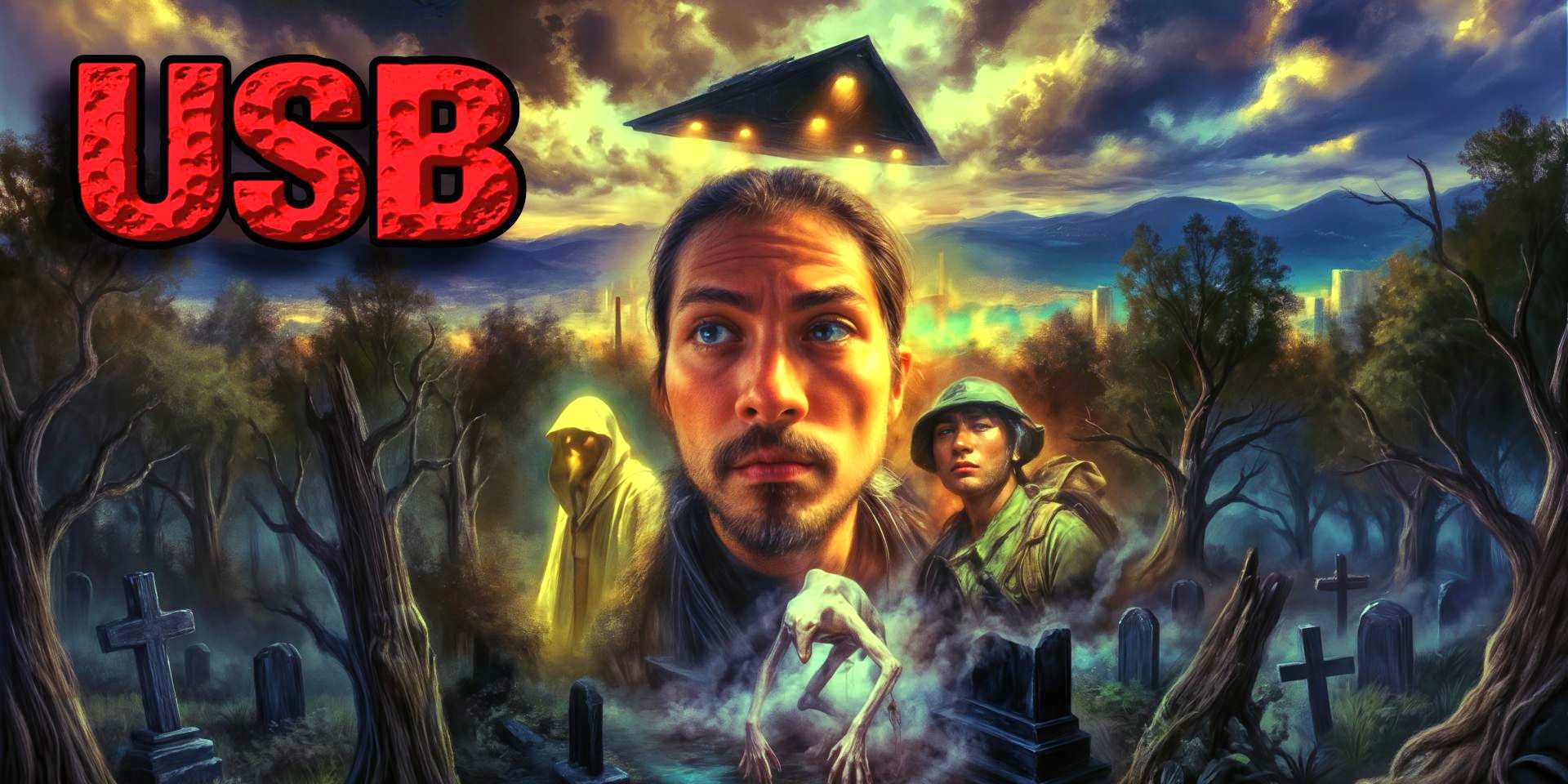
I’ll be honest: when I sat down with an early review copy of USB, the new feature from Kai Laigo Productions, I didn’t know what to expect. The title alone offers almost nothing — a blunt, three-letter provocation sitting in raw crimson letters against a black screen like a dare. By the time the credits rolled 59 minutes later, I was still processing what I had just witnessed. And I mean that as the highest possible compliment.
USB is a film entirely generated by artificial intelligence — visually, compositionally, stylistically — and it announces that fact not with apology but with swagger. What director and producer Kai Laigo has assembled here is less a movie in the conventional sense and more a detonation: a genre-annihilating, reality-bending fever dream that gleefully cannibalizes the entire history of cinema and spits it back out in a form that is simultaneously alien and deeply, strangely familiar.
The Scope of It
Nothing prepares you for just how much ground USB covers in under an hour. The film opens in lush jungle — a colossal, spike-backed reptilian creature towering over a helmeted soldier who is, improbably, trying to reason with it. Before you’ve fully registered the absurdity, you’re cut to a black-and-white naval battle that looks like wartime newsreel footage, except the physics are slightly wrong and the smoke billows with a beauty that no real explosion ever managed. Then robed, backpack-wearing pilgrims standing at a bonfire while a skull-faced spirit rises from the flames. A demon-masked figure in a Santa suit triumphantly raising a shotgun in a parking garage. A snarling werewolf aboard a spacecraft. A red laser beam splitting a foggy cemetery in two. A memorial bench reading Beloved Grandpa Leonard, sitting peacefully in a sunny meadow, somehow the most unsettling image of them all.
And those are just the moments I can describe in isolation. There are sequences that defy easy summary — a confrontation between a crimson-skinned, hyper-muscled figure and a bearded man in a business suit, both of them standing before a crucifix in a gray, featureless room, apparently mid-argument about something enormous. The AI renders their gestures with an almost theatrical precision that is stranger and more compelling than photorealism would ever be.
Why It Works
Films like USB could easily collapse into incoherence, and the fact that this one doesn’t is a genuine achievement. Laigo has a strong instinct for rhythm. Each image is held long enough to land, short enough to keep you hungry. The film understands that in the absence of conventional plot, momentum becomes the narrative — the feeling that something is building, that all these fragments are cells of a larger organism you haven’t yet seen whole.
The visual range on display is staggering. The AI renders everything from the gritty, hand-held texture of found-footage horror to lush, over-saturated creature-feature spectacle to the clean, cool geometry of a sci-fi interior. Crucially, Laigo doesn’t flatten these styles into a single homogenous aesthetic. Each segment has its own tonal fingerprint, and the juxtapositions are deliberate: comedy brushes up against dread, grandeur against absurdity. The memorial bench appears between two scenes of carnage and reads like a poem.
The sound design deserves particular mention. Working with AI-generated audio that is periodically wrong in exactly the right way — a footstep that’s half a beat late, a score that swells into something you don’t quite have a name for — USB creates a persistent, low-grade unease that keeps you alert even in its quieter passages.
A New Kind of Cinema
There will be critics who argue that a film without human actors, without a screenplay in the traditional sense, without a cinematographer making choices in real time, is not really a film at all. I’d invite those critics to watch USB and make that argument with a straight face.
What Laigo has demonstrated here is that AI filmmaking has crossed a threshold. This is not a tech demo. It is not a curiosity. It is a work with genuine aesthetic ambition, a coherent (if unconventional) point of view, and the ability to produce images that stay with you. The giant lizard staring down at the tiny soldier. The Santa demon with arms raised in some private, terrible triumph. The red beam splitting the cemetery like a wound. These are images, in the fullest cinematic sense — compositions that carry meaning beyond their immediate content.
At 59 minutes, USB is also ruthlessly self-disciplined. It doesn’t overstay its welcome or pad its runtime to seem more substantial. It arrives, it overwhelms, it ends. You will want to watch it again.
Final Thoughts
USB is not a film for everyone, and it knows it. It demands a viewer willing to surrender the usual anchors of character and plot and simply ride the current of image and tone. For that viewer, it is one of the most exciting things I’ve seen in a long time — a proof of concept that doubles as genuine art, a 59-minute argument that the future of cinema is stranger and wilder and more interesting than anyone predicted.
Kai Laigo Productions has made something genuinely new here. Pay attention to this name.